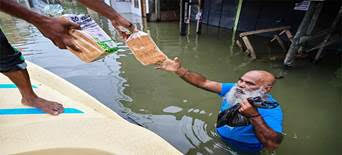
There has been a rare consensus of opinion in the country that the government’s humanitarian response to the sinking of Iran’s naval ship IRINS Dena was the correct one. The support has spanned the party political spectrum and different sections of society. Social media commentary, statements by political parties and discussion in mainstream media have all largely taken the position that Sri Lanka acted in accordance with humanitarian principles and international law. In a period when public debate in Sri Lanka is often sharply divided, the sense of agreement on this issue is noteworthy and reflects positively on the ethos and culture of a society that cares for those in distress. A similar phenomenon was witnessed in the rallying of people of all ethnicities and backgrounds to help those affected by the Ditwah Cyclone in December last year.
 The National Peace Council of Sri Lanka
The National Peace Council of Sri Lanka
The National Peace Council of Sri Lanka