

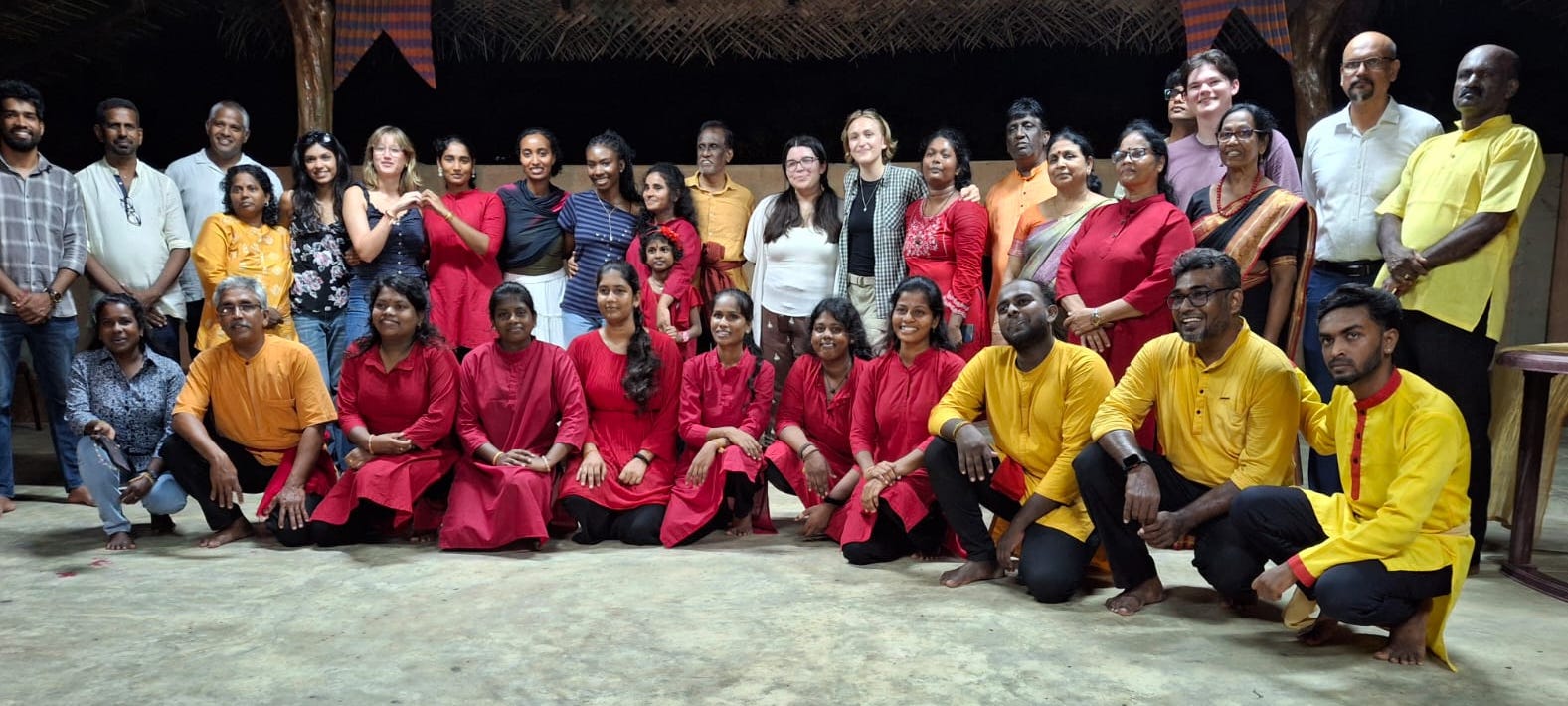
NPC hosted a short term study abroad programme for eight students from Wake Forest University in the US on pluralism across religious and cultural differences led by Dr. Eranda Jayawickreme, the Harold W. Tribble Professor of Psychology at Wake Forest University, designed as an immersive learning journey through Sri Lanka’s complex social, religious, ethnic and cultural landscape.
Coordinated by NPC with the support of partner organisations, academics, civil society actors, religious leaders and local community representatives, the programme reflected NPC’s long-standing commitment to coexistence, reconciliation, interfaith understanding and democratic engagement. By combining academic learning with exposure to lived realities, it enabled students to examine pluralism not only as a concept but as a daily practice shaped by history, identity, conflict, memory, resilience and hope.
The visit began in Colombo where students were introduced to Sri Lanka’s political and social context and the structure of the study tour. At NPC, they learned about the organisation’s work in peacebuilding, religious coexistence, transitional justice, civic education and community level reconciliation through the sharing of experiences by Executive Director Dr. Jehan Perera, Chairperson Dr. Joe William, Programme Advisor Sumadhu Weerawarne Perera and staff. This session provided the foundation for the rest of the journey, helping students understand the broader national context within which local experiences of coexistence and conflict transformation are situated.
The Colombo segment included visits to multi-religious and cultural landmarks, including Gangaramaya Temple, St. Anthony’s Shrine and Sri Ponnambalawaneswaram Temple, enabling students to observe how religious traditions coexist in an urban setting and how sacred spaces contribute to the cultural and spiritual identity of the city.
From Colombo the group travelled to Hatton to engage with the Malaiyaha Tamil community in the plantation sector. This was an important component of the programme as it offered students an opportunity to understand the historical marginalisation, identity struggles and continuing socio-economic challenges faced by plantation communities. Discussions focused on identity, citizenship, labour, dignity, social inclusion and coexistence, highlighting the need for pluralism to also address structural inequalities and the voices of communities often kept at the margins of national narratives.
The group then experienced a symbolic spiritual experience with a night climb of Adam’s Peak. Revered by Buddhists, Hindus, Muslims and Christians, the mountain is one of the most powerful examples of a shared sacred landscape. The climb allowed students to experience pluralism in practice as pilgrims from different religious and cultural backgrounds journeyed together in a common act of devotion, endurance and reflection.
The group also visited the Temple of the Tooth Relic in Kandy and historical and religious sites in Anuradhapura that reflect the ancient civilisation and Buddhist heritage and provided the historical depth to the study of Sri Lanka’s plural society, showing how religion, governance, culture and identity have shaped the country over centuries. The group then travelled North through Mullaitivu, Mullivaikkal and Nandikadal, locations closely associated with the final stages of the civil war. This part of the journey created space for difficult but necessary reflection on memory, loss, post-war recovery and the responsibilities of reconciliation.
In Jaffna, the programme combined academic learning, cultural immersion and community engagement. The group visited Nagadeepa or Nainativu, an island where Buddhist, Hindu and Muslim religious sites are located in close proximity, offering another example of the multi-religious landscape. At the University of Jaffna, students participated in sessions with scholars including Dr. M. Thiruvarangan of the Department of Linguistics and English, Dr. P. Ahilan of the Department of Fine Arts, Dr. S. Jeevasuthan of the Department of Sociology and Mrs. Kosalai Mathan of the Department of Law. Topics included ethno-nationalist projects and coexistence, state heritage policies and minority rights, pluralism in societies affected by violence, female-headed households, power devolution and the challenges of enforcing the 13th Amendment. The discussions enabled students to engage with perspectives from the North, a region affected by war and its aftermath. The sessions encouraged critical thinking on nationalism, identity, minority rights, devolution, memory, gender and post-war social transformation while helping students connect theoretical learning with the experiences of communities navigating the long term consequences of violence and division.
A highlight of the Jaffna visit was the cultural immersion activity with the Theatre Action Group founded by Dr. K. Sithamparanathan. Through participatory theatre, music, song, dance and storytelling, students were introduced to the use of art as a tool for healing, dialogue and community transformation. The experience demonstrated how cultural expression can help people confront fear, express emotion, preserve memory and rebuild relationships after conflict. The group also met civil society organisations and activists working on post-conflict reconciliation, community recovery and social justice and visited key sites in Jaffna including the Jaffna Public Library, Jaffna Fort and St. Mary’s Cathedral.
The students then visited the Shrine of Our Lady of Madhu and met Fr. Peppi Sosai, Administrator of Madhu Church. Madhu is a place of deep spiritual and historical significance, especially for communities affected by the conflict. The discussion with Fr. Sosai offered valuable insights into faith, displacement, humanitarian response, recovery and coexistence in a region marked by both suffering and resilience. It also highlighted the role religious institutions can play in providing refuge, healing and moral leadership during times of crisis.
Back in Colombo, students engaged with academics at the University of Colombo, including Prof. Mohamed Mahees of the Department of Sociology, Dr. Pavithra Jayawardena of the Department of International Relations and Dr. Crishni Silva of the Department of Political Science and Public Policy. The sessions focused on the impact of undergraduate stress on relationships, ethnic harmony and pluralism, diversity and pluralism in post-conflict Sri Lanka and Islamophobia after the Easter Sunday attacks. These discussions allowed students to examine pluralism in relation to contemporary social anxieties, fear, youth experiences and university life.
The Colombo programme included meetings with key civil society organisations such as the Centre for Policy Alternatives and the International Centre for Ethnic Studies. Through these engagements, students gained insight into the role of civil society in democracy, human rights, social cohesion, policy reform and public dialogue and how such organisations help sustain democratic space in a complex political environment.
On the final day the group visited the University of Ruhuna where they met Dr. R.A.S.P. Ranabahu of the Department of Geography and Mr. Upul Sanjeewa Wijepala of the Department of Sociology, who presented on the demographic and spatial dimensions of pluralism and southern perspectives on religious and cultural coexistence.
The programme concluded with a group reflection and farewell dinner where students shared their key learning outcomes and personal reflections from the journey.
The Wake Forest University study abroad programme provided a meaningful and holistic learning experience across regions, communities, histories and identities. It enabled students to encounter Sri Lanka’s diversity through temples, churches, universities, civil society spaces, cultural performances, community discussions and sites of memory. More importantly, it encouraged them to understand pluralism as an ongoing process that requires empathy, justice, dialogue, inclusion and the courage to listen across difference.
For NPC, the programme was an opportunity to share its peacebuilding experience with an international student group and strengthen global learning partnerships rooted in mutual understanding. The study tour demonstrated that Sri Lanka’s experiences of conflict and coexistence offer important lessons not only for the country but also for young people and educators around the world committed to building more inclusive, peaceful and plural societies.