

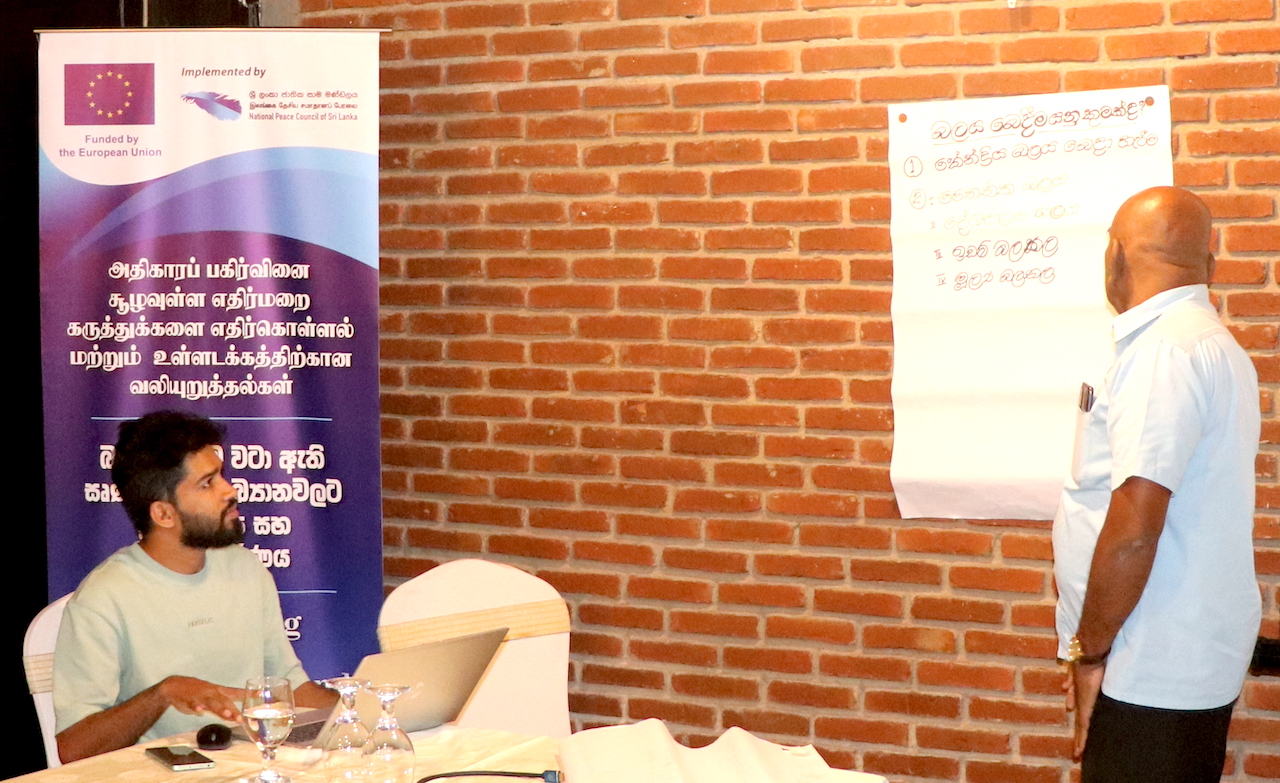
The Active Citizens for Electoral Democracy (ACED) project, funded by the European Union, conducted youth engagement programmes in Nuwara Eliya, Jaffna and Mullaitivu, strengthening democratic awareness and meaningful political participation among young people. These initiatives form part of ACED’s continued efforts to promote inclusive governance, electoral reform dialogue and youth leadership in democratic processes.
At the Nuwara Eliya programme, which brought together over 35 youth participants, discussions were contextualised within recent political developments, including the 2022 aragalaya that reshaped national dialogue on accountability and governance reform. Participants engaged in interactive group exercises reflecting on the political landscape, electoral participation, youth and women’s representation, sub-national governance and accountability mechanisms. The session emphasised that power sharing is a democratic and constitutional mechanism that strengthens unity through inclusive governance, particularly in diverse districts such as Nuwara Eliya.
A second youth training was conducted in Jaffna with the participation of 34 youth members. Group discussions focused on the need for social interaction, decentralisation, land issues, responsibilities of people’s representatives and the role of provincial and local government councils. Participants raised concerns regarding limited responsiveness of public officials, language barriers in service delivery, land ownership and archaeological demarcation issues, accountability for the disappeared and the importance of meaningful devolution of power. The dialogue reflected both critical awareness and a strong desire for institutional accountability.
In Mullaitivu, youth and civil society leaders engaged in discussions on democratic participation, local governance and electoral responsibility, emphasising the need for stronger community consultation, youth inclusion in political decision making and improved institutional responsiveness and power devolution. Many participants highlighted the importance of addressing local grievances through democratic means and recognised the role of political and administrative authorities in sustaining civic engagement and decentralisation for a better service delivery mechanism and the need for devolution of power for a better decision making process.
Across the three districts, participants demonstrated strong political awareness and thoughtful engagement. Young women in particular showed an understanding of ethnic harmony and rights-based democratic participation. Many university students expressed interest in contributing articles to media platforms and continuing civic discussions while some indicated willingness to consider future electoral participation. Through sustained civic education and youth network strengthening, the project continues to empower young citizens to move beyond passive voting and become informed, responsible and active changemakers within the democratic framework.